



















Japanese enterprises have made significant progress in AI adoption over the past two years. Yet as the technology matures, the challenge is shifting from experimentation to execution.
Recent discussions among more than 300 Japanese business leaders at FPT Halong Sapphire Summit in July 2026 reveal an important reality: AI adoption is no longer the primary hurdle. Most organizations have already moved beyond exploration. According to a maturity assessment conducted during the event, 38% of respondents identified themselves at the "Augmented" stage, where AI is improving individual productivity, while another 30% have begun implementing governance and more structured adoption practices. The next challenge is turning these early successes into sustainable enterprise-wide capability.
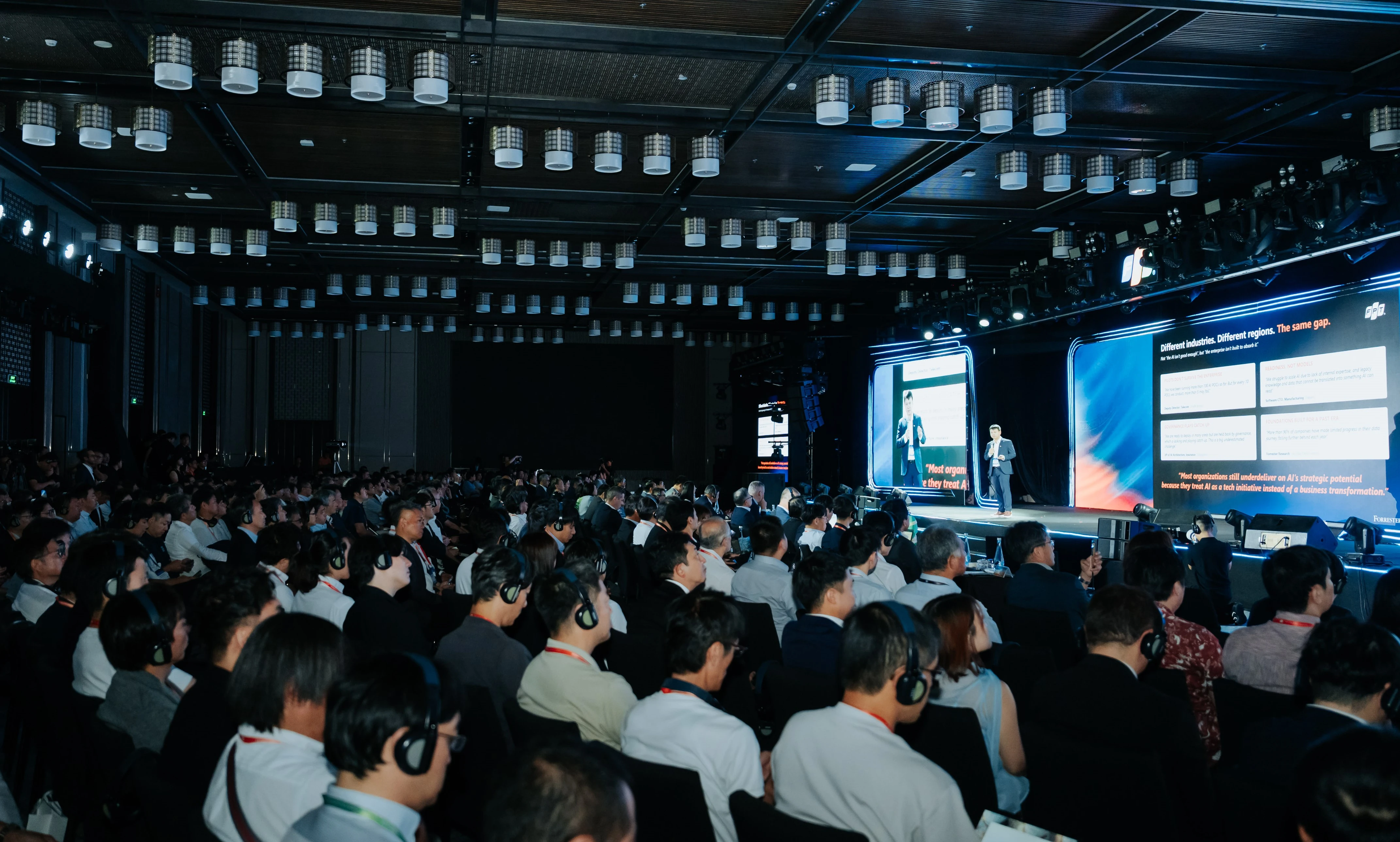
This mirrors broader market trends. McKinsey has projected that generative AI could help address Japan's structural challenges around labor shortages and productivity, while Gartner continues to highlight that the biggest obstacles to AI value creation are no longer technological but organizational—governance, operating models, talent, and the ability to scale beyond pilots.
The question facing Japanese enterprises today is therefore not whether AI works. It is how to industrialize AI while preserving the trust, quality, and operational discipline that have long defined Japanese business excellence.
The AI Scaling Gap
One of the most striking themes was the widening gap between AI adoption and AI value. Across global markets, 88% of enterprises already use AI and 85% are increasing AI investments. Yet only 39% report measurable enterprise-wide financial impact, while 56% of CEOs still see limited impact on revenue growth or cost reduction.
As he addressed an audience of Japanese business and technology leaders across industries, FPT Corporation EVP and FPT Software CEO Pham Minh Tuan noted: "The challenge is no longer proving that AI works. The challenge is scaling it across the enterprise—securely, responsibly, and in a way that creates measurable business value."
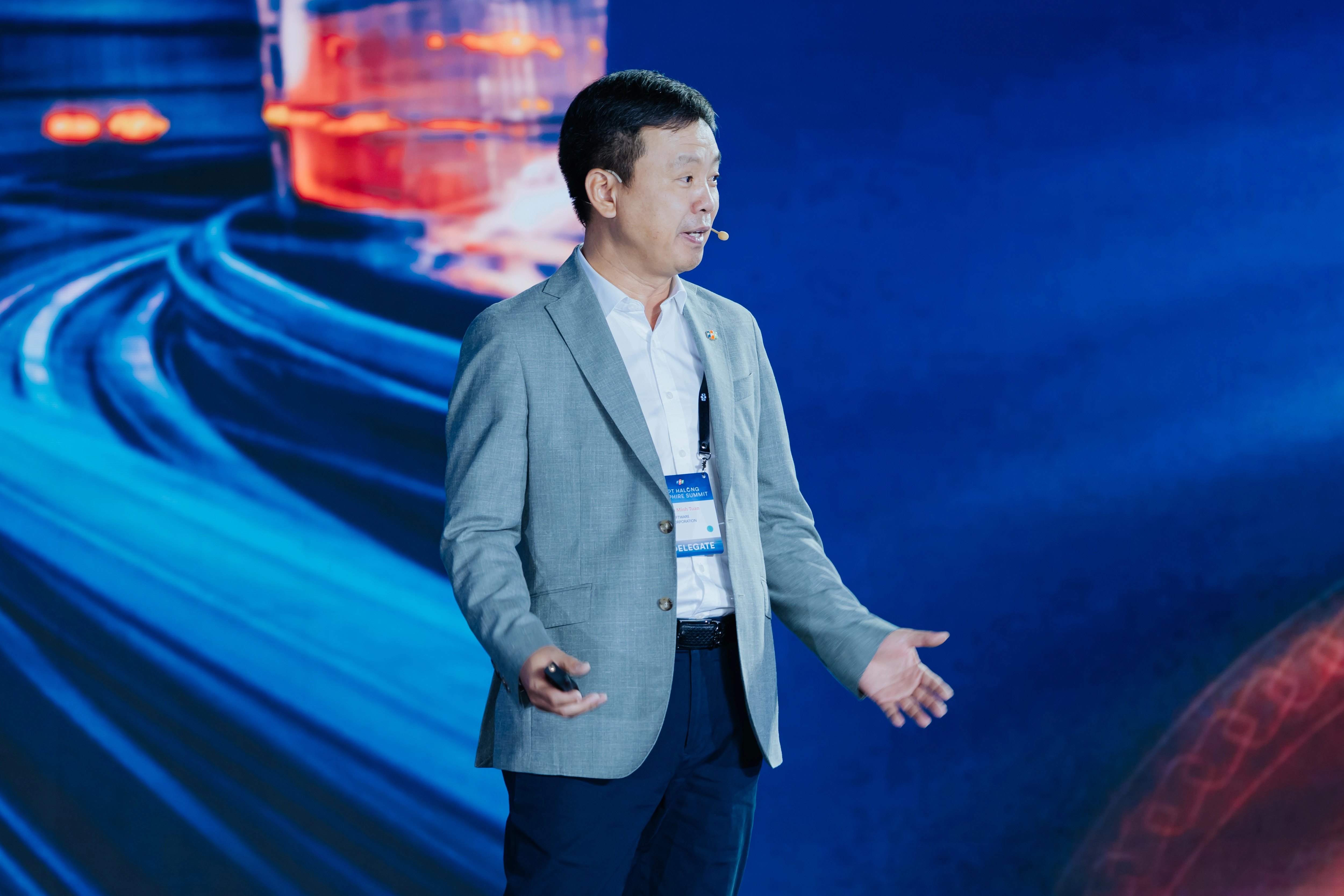
Pham Minh Tuan, FPT Corporation EVP and FPT Software CEO, outlines the barriers to enterprise AI scale and the path to secure, responsible, and measurable value
His keynote framed four barriers that continue to slow enterprise AI adoption. The first is execution: many pilots demonstrate value in controlled environments but fail to move into production or across organizational boundaries. AI value is not created in isolated PoCs; it emerges when AI becomes embedded into enterprise workflows and operating models.
The second is trust. 40% of organizations have already experienced an AI-related privacy or security incident, while over 60% still lack structured AI risk assessment practices. At the same time, control over data, infrastructure, and sovereignty is becoming a core competitive issue, with 71% of leaders viewing sovereign AI as a strategic or existential priority.
The third is legacy burden. In many enterprises, 60–80% of IT spending remains tied to maintaining existing systems rather than driving transformation. These environments are business-critical, but they can slow innovation, limit integration, and keep senior talent locked into low-value maintenance work.
The fourth is people transformation. According to the World Economic Forum, 59% of the global workforce will require reskilling or upskilling by 2030. AI transformation therefore demands a change in how people work, decisions governed, and how organizations learn.
Taken together, these challenges show why AI transformation is fundamentally different from previous waves of digital transformation. Enterprises must modernize foundations, strengthen trust, redesign operating models, and prepare workforces for an AI-native future — all at the same time. This is where FPT positions itself: helping organizations run and transform simultaneously through CASAN, FleziPT, Digital Foundry, and a broader portfolio of AI-powered capabilities designed to move enterprises from experimentation to impact.
These themes also set the stage for the broader discussion that followed: how enterprises redesign delivery models, modernize foundations, and build trusted AI operations at scale.
Beyond Productivity: Redesigning the Enterprise
If the first wave of AI was about productivity, the next wave is about redesigning how enterprises create value.
Frank Bignone, SVP and Head of Corporate Strategy & Growth at FPT Software, argued that AI is fundamentally changing the economics of technology delivery. "The future of enterprise technology services will not be defined by how many people are assigned to a project. It will be defined by how effectively organizations combine human expertise, AI agents, governance, and accumulated knowledge to deliver business outcomes."
At the heart of this vision is FPT Digital Foundry—an operating model designed to move enterprises from effort-based delivery to outcome-based delivery.
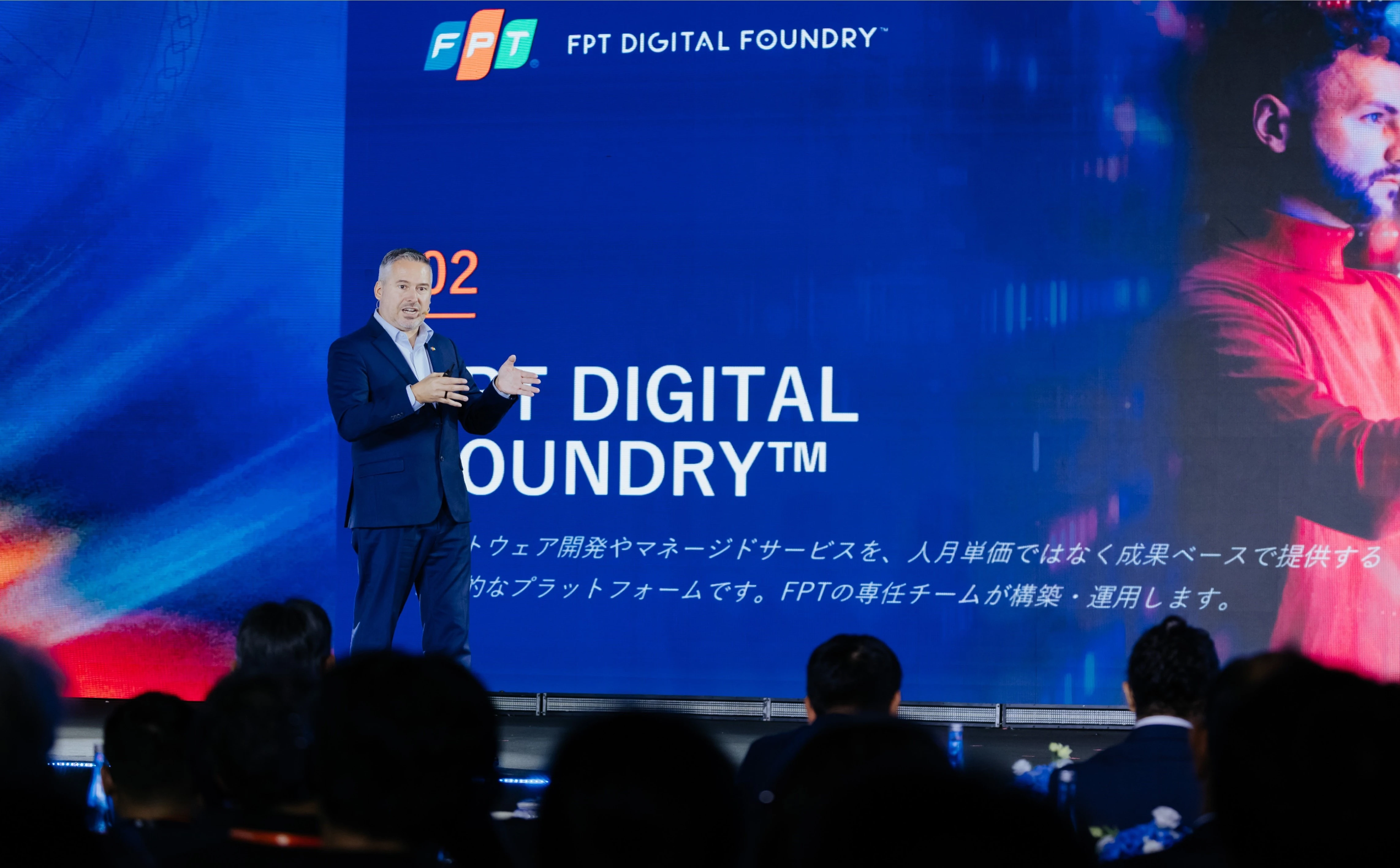
Frank Bignone introduces FPT Digital Foundry™ as a new delivery model designed for the age of AI and agentic engineering
Historically, technology services have been measured by capacity and hours worked. AI challenges that model. When productivity gains are increasingly generated by AI agents rather than additional headcount, enterprises care less about effort and more about outcomes: speed, quality, predictability, and business impact.
Digital Foundry addresses this shift through four core elements: governed AI agents, enterprise-wide governance, continuously compounding organizational knowledge, and commercial models aligned to business outcomes. Rather than treating AI as a collection of tools, it embeds AI into the entire delivery lifecycle—from development and testing to operations and managed services.
The results are already measurable. FPT reports more than 30% gains in software delivery velocity, while 60–90% of Level 1 support tickets can be resolved automatically through AI agents. The platform also incorporates ISO 42001-aligned governance, ensuring every AI action remains auditable and accountable.
The importance of governance was echoed by Microsoft’s Dr. Yassine Serhane, who emphasized that successful AI transformation requires more than technology adoption. "Organizations are no longer asking what AI can do. They are asking how quickly they can transform while maintaining trust and control,” said Dr. Serhane. “The challenge is not simply adopting AI—it is redesigning work, processes, and culture so AI can create value consistently across the enterprise."
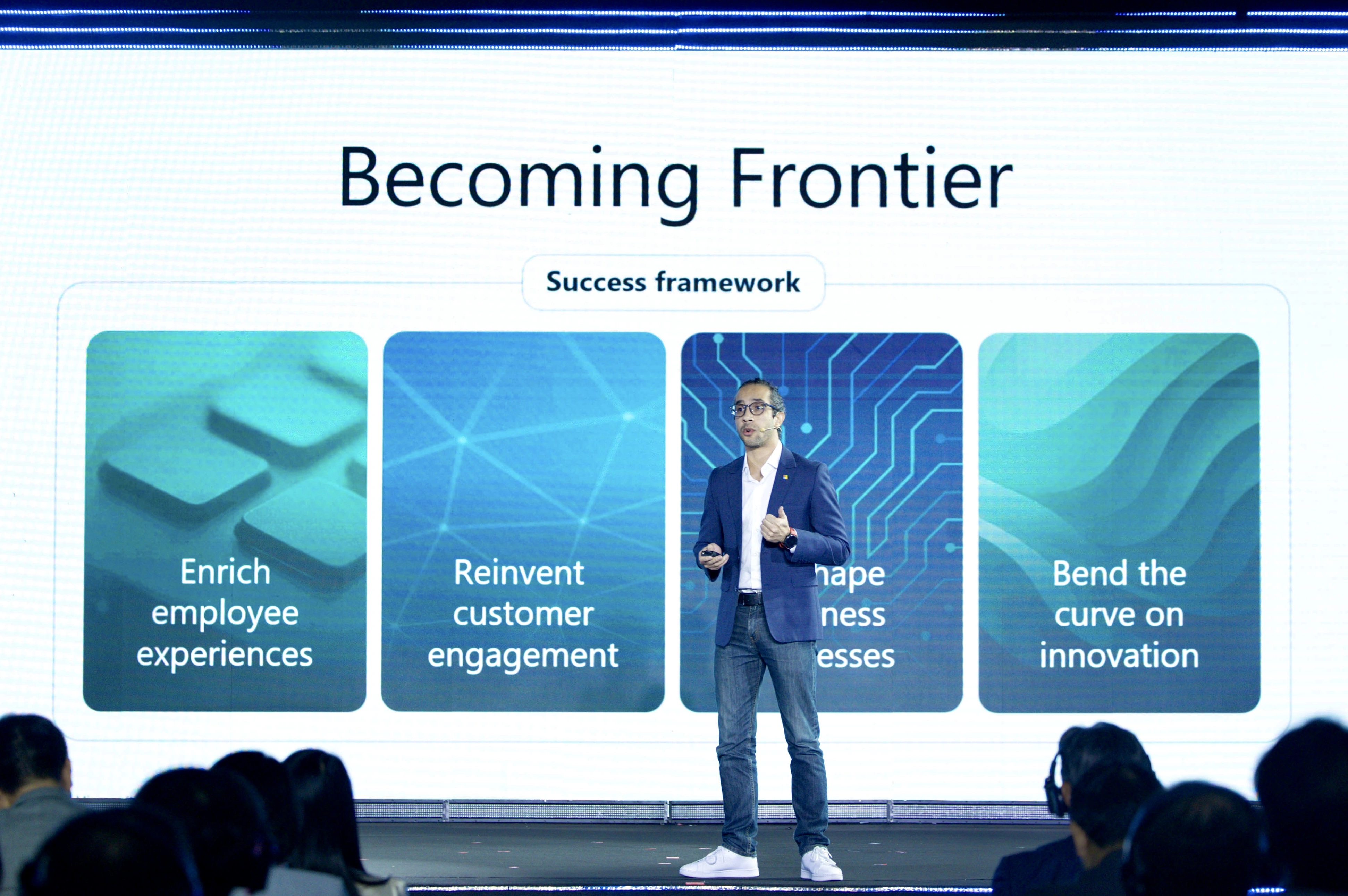
Dr. Yassine Serhane emphasizes that AI requires a fundamental shift in how work is designed
This perspective is reinforced by the latest Microsoft Work Trend Index research. While 66% of AI users report spending more time on high-value work and 58% say AI helps them produce work they could not have generated a year ago, organizational factors account for more than twice the impact of individual AI adoption alone. The implication is clear: enterprise AI success depends less on tools than on transformation.
Modernizing the Foundations
For many Japanese enterprises, AI transformation begins with a much older challenge: legacy systems, which slow innovation, constrain agility, and depend heavily on specialized expertise that is becoming increasingly scarce. In fact, industry estimates suggest that 60–80% of enterprise IT spending is still dedicated to maintaining existing systems rather than driving transformation initiatives.
Teruyasu Kameyama, Managing Director of Solution Consulting at FPT Japan, framed modernization as a business transformation rather than a technology upgrade. "By combining AI, proven methodologies, and specialized talent, we can accelerate transformation while preserving the business knowledge embedded in decades of enterprise systems."
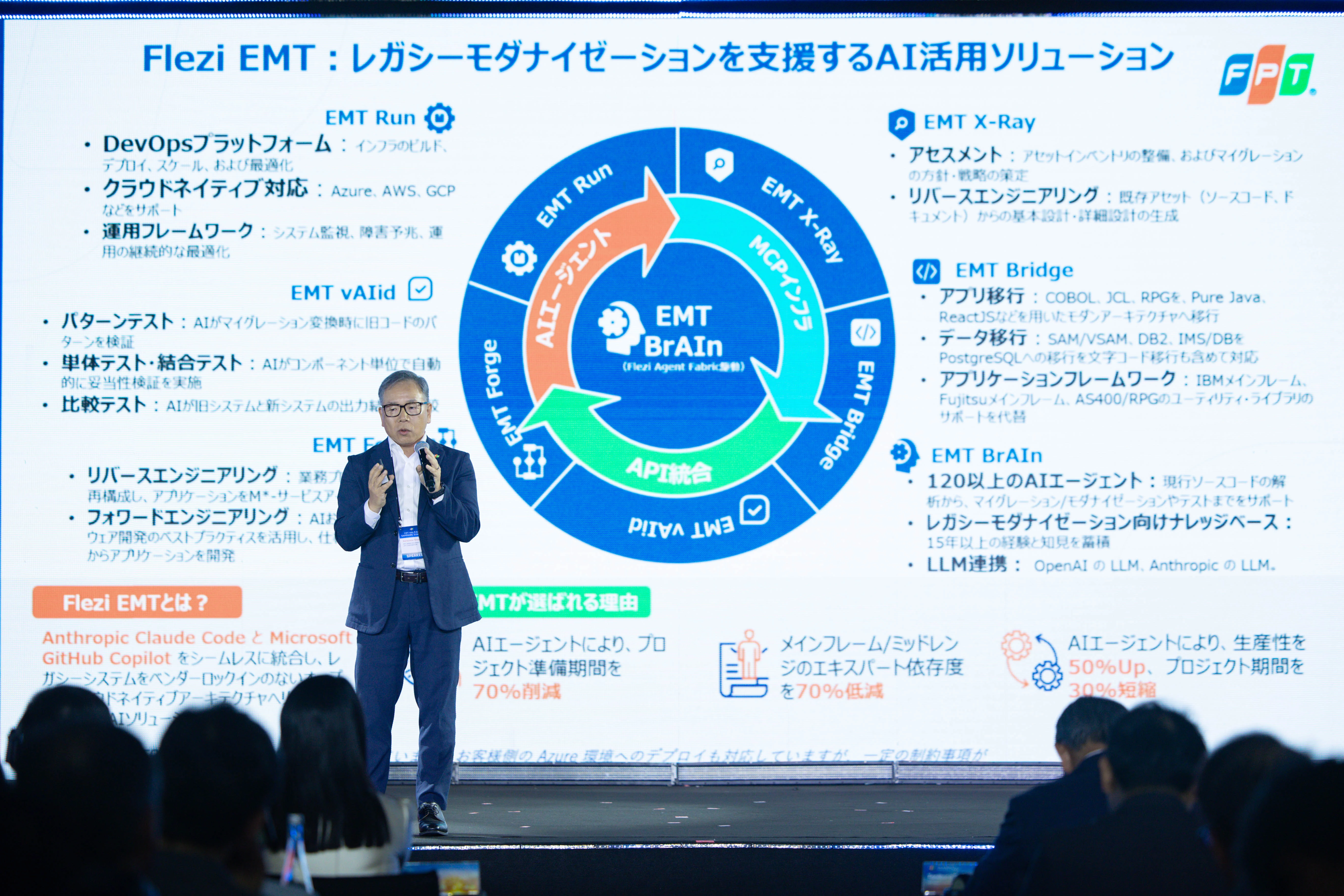
Teruyasu Kameyama outlines how AI is reshaping legacy modernization
FPT’s modernization approach combines AI-powered analysis, modernization frameworks, and specialist talent pools to reduce both risk and dependency on legacy expertise. The company reports a 70% reduction in project preparation time, a 70% reduction in dependency on legacy-system experts, productivity gains of up to 50%, and project timelines shortened by approximately 30%.
The discussion also extended to enterprise operations and core business platforms. According to Endo Akihiro, Executive Director of FPT Consulting Japan, organizations that standardize processes, strengthen data quality, and continuously improve operations will be far better positioned to realize value from AI.
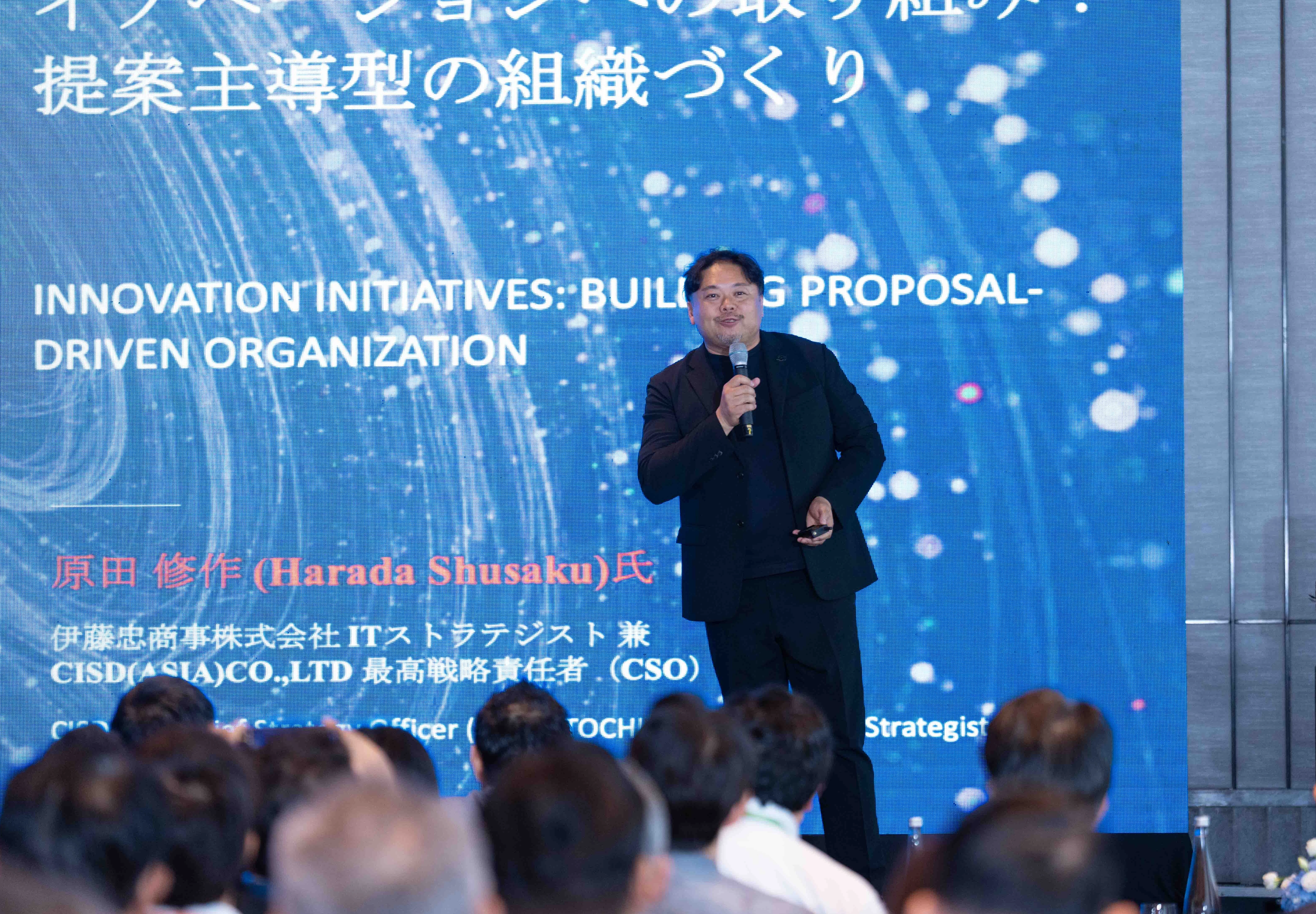
Endo Akihiro highlights high-quality SAP and ERP data as the foundation of AI success
Building on this vision, FPT is reimagining enterprise operations through a model described as "Global × AI"— combining standardized processes, shared knowledge assets, and AI-driven automation to create self-improving operations. Rather than treating SAP support as a maintenance function, the approach focuses on continuously capturing operational knowledge, accelerating issue resolution, improving testing and change management, and using AI to transform operational signals into actionable business insights. Enterprise operations then become not only more resilient and efficient, but also a source of faster decision-making and business agility.
Trust as a Strategic Advantage
While AI creates new opportunities, it also dramatically changes the threat landscape. This was one of the most urgent topics discussed during the event.
As Pham Tung Duong, VP and Director of CyberSecurity Assurance Service at FPT Software emphasized, AI-powered systems identified more than 23,000 vulnerabilities in under 60 days; and the fastest recorded attack moved from initial access to full compromise in just 27 seconds. The average exploit window now stands at only 1.6 days, while enterprises still require an average of 21 days to remediate critical vulnerabilities. Meanwhile, AI-driven attack activity has increased by 89% year over year.
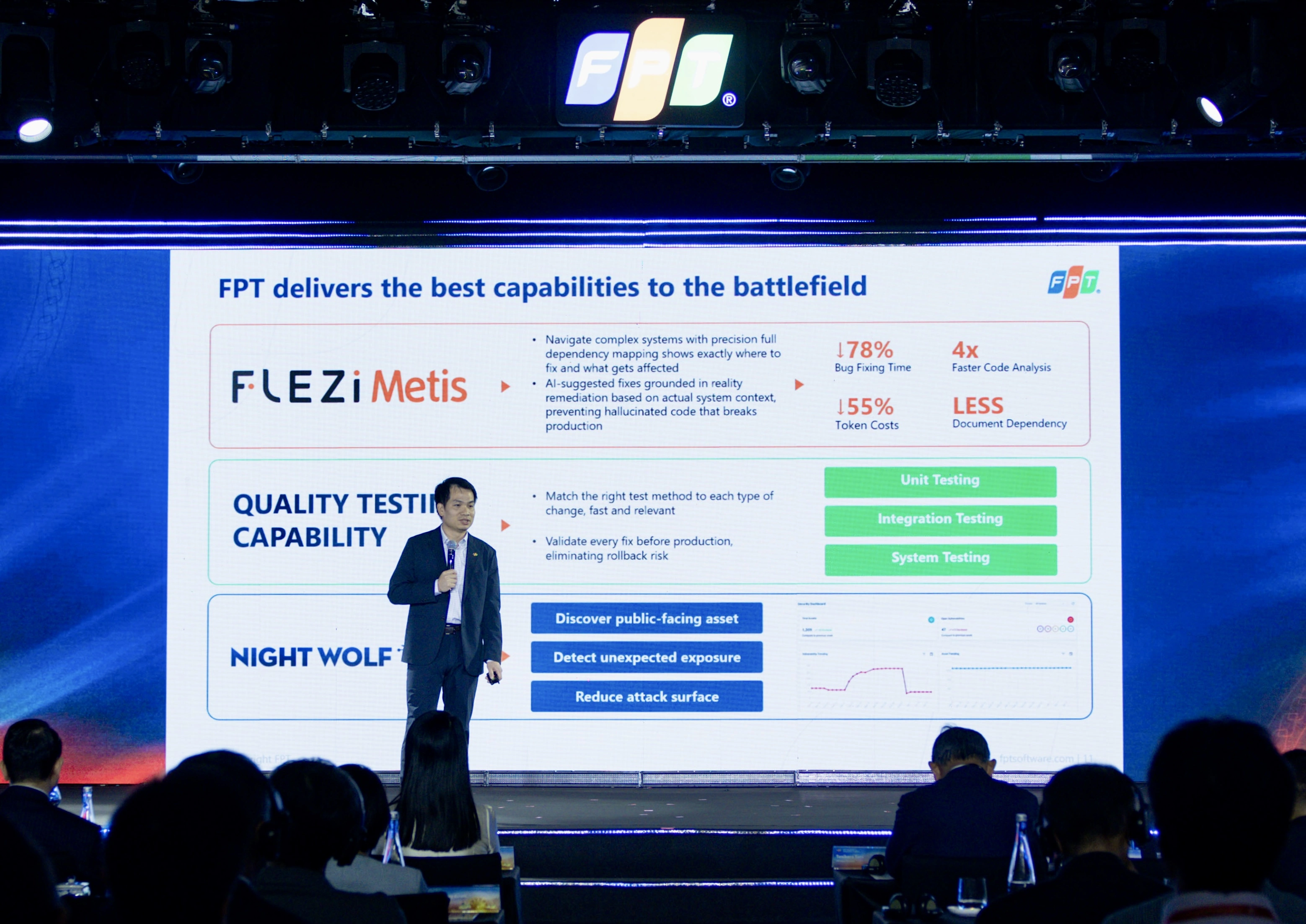
Pham Tung Duong spotlights Patch the Enterprise, a strategic initiative for navigating fast-evolving cyber risks in the AI era
The result is an increasingly dangerous imbalance between attackers and defenders. "In the AI era, cybersecurity can no longer be reactive. Organizations must move from finding vulnerabilities to continuously identifying, prioritizing, and remediating them before attackers can act,” shared Duong. “That is the thinking behind FPT’s Patch the Enterprise program."
This shift from reactive security to proactive remediation sits at the core of FPT’s cybersecurity strategy. Rather than treating cybersecurity as a separate function, FPT combines security specialists, software developers, DevOps engineers, cloud experts, infrastructure teams, and quality assurance professionals into a unified remediation model that can operate across the entire technology stack.
The company’s approach leverages AI to prioritize risk, understand complex codebases, identify potential vulnerabilities, accelerate remediation, and validate fixes before deployment. In one large-scale engagement, FPT mobilized 77 teams across five major systems and resolved more than 900 backlog vulnerabilities in a highly compressed timeframe. Another implementation reduced over 850 vulnerabilities to zero using AI-assisted remediation workflows.
For Japanese enterprises, where operational continuity is paramount, this ability to combine speed with reliability may become a critical competitive advantage. Trust is no longer simply a compliance requirement—it is becoming an enabler of AI scale.
A Long-Term Partner for Japan’s AI Transformation
The common thread running through every discussion was clear: AI transformation is no longer a technology initiative alone. It requires modernized foundations, trusted operations, new delivery models, workforce transformation, enterprise governance, and a clear roadmap from experimentation to scale. The organizations that succeed will be those that can connect these elements into a coherent transformation journey.
This is where FPT positions itself. As Pham Minh Tuan outlined, enterprises face four interconnected challenges on their path to AI scale: moving beyond pilots, modernizing legacy environments, strengthening trust and cybersecurity, and transforming the workforce. FPT's response begins with CASAN, a structured maturity framework that helps organizations navigate their journey from experimentation to AI-native operations. It is complemented by FleziPT, which brings together FPT's AI capabilities and solutions portfolio, including Flezi Aurora for AI-powered managed services, Flezi NEXT for legacy modernization, Flezi Metis for transforming institutional knowledge into AI-ready assets, Flezi Shugo for proactive cybersecurity, and Flezi Galaxy for governance and large-scale AI operations.
Together with Digital Foundry, FPT's agentic delivery model, and its sovereign AI infrastructure through FPT AI Factory, these capabilities help enterprises run, transform, and scale simultaneously—moving from isolated AI initiatives to enterprise-wide adoption and measurable business outcomes.
More importantly, FPT's positioning in Japan has evolved alongside the market itself. What began as a software engineering business more than two decades ago has progressively expanded into consulting, business transformation, modernization, AI, and industry-specific solutions. As Nguyen Huu Long, CEO of FPT Consulting Japan noted, Japanese enterprises are no longer looking purely for execution capacity. They increasingly seek partners that can help shape strategy, redesign operating models, and navigate transformation end-to-end. FPT's journey in Japan reflects that same transition—from technology delivery to strategic transformation support.
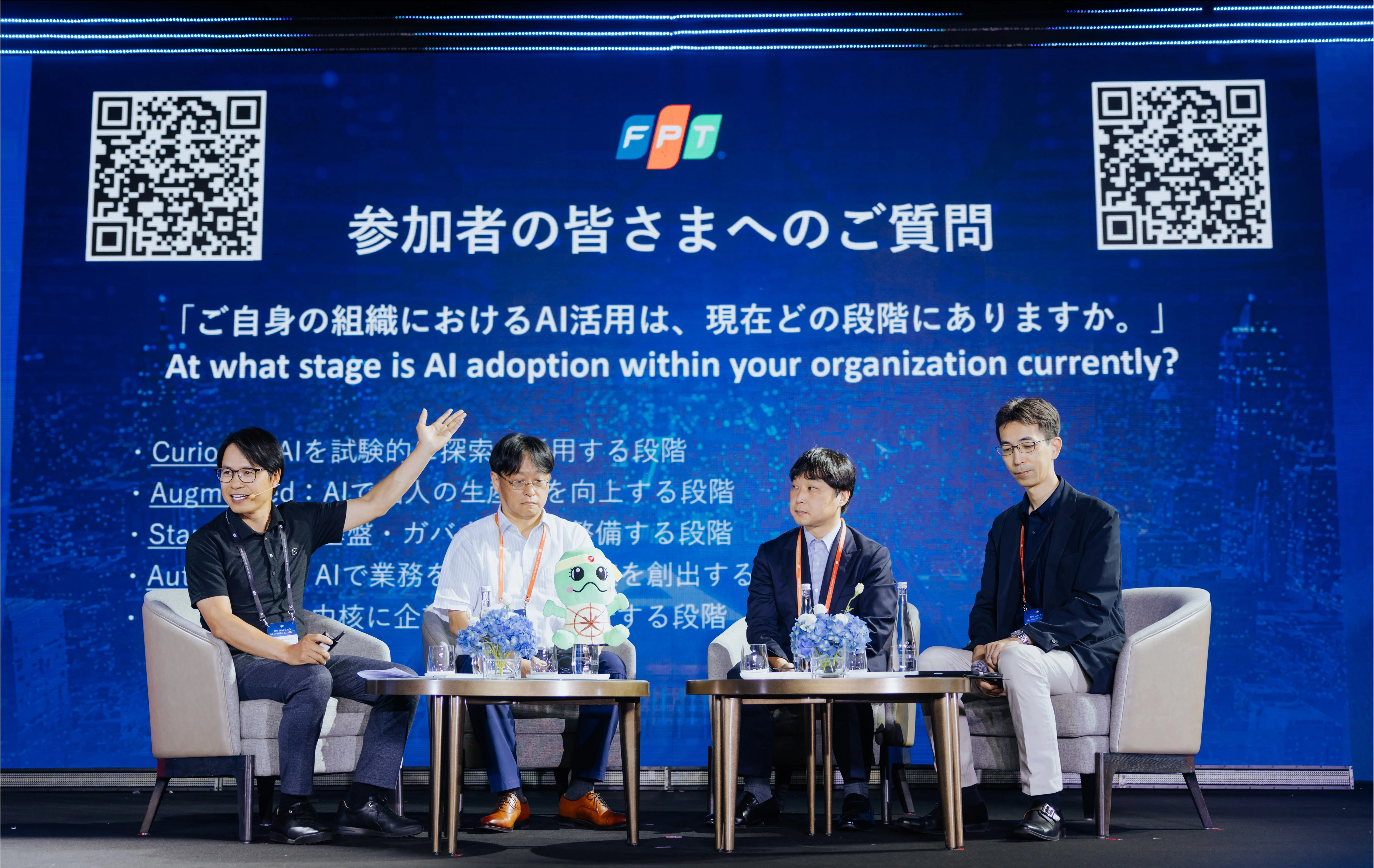
Moderated by Long Nguyen Huu, the panel discussion focused on turning AI experimentation into measurable business value
That commitment is matched by significant long-term investment. In 2025, FPT's AI Factory infrastructure in Vietnam and Japan entered the TOP500 ranking of the world's most powerful supercomputing systems, reinforcing the company's ambition to provide sovereign AI capabilities for customers globally, including Japan. The company has continued to expand this infrastructure through advanced NVIDIA GPU technologies, providing enterprises with access to scalable AI computing resources while maintaining control over data, governance, and compliance requirements.
FPT has also invested heavily in talent development to serve the Japanese market. Beyond technical training, the company committed VND125 billion to developing Japanese-language ICT talent, reflecting its belief that successful transformation depends not only on technology but also on deep cultural understanding, industry knowledge, and effective collaboration between teams in both countries.
Today, FPT's presence in Japan extends across some of the country's most important industries. Recent partnerships and transformation initiatives span aviation, manufacturing, automotive, financial services, energy, and industrial operations. These include collaborations with organizations within the ANA Group ecosystem, major Japanese financial institutions, leading automotive manufacturers, top energy providers, and manufacturing companies pursuing AI-enabled operations and digital transformation.
This growing footprint is supported by a broader ecosystem of more than 1,100 clients globally, over 130 Fortune Global 500 customers, strategic partnerships with Microsoft, NVIDIA, SAP, and Anthropic, and a workforce of more than 30,000 AI-augmented engineers. Yet the ambition extends beyond scale.
As Dr. Yassine Serhane noted during the event, "A frontier company is a company that has put AI at the center of its business. This is something that I can proudly say FPT has already achieved. They're already there. Microsoft and FPT can now come together to help customers reach that frontier level."
That ambition sits at the heart of FPT's vision for Japan. By combining the CASAN transformation framework, FleziPT's portfolio of AI-powered capabilities, Digital Foundry's agentic delivery model, sovereign AI infrastructure, and a growing ecosystem of industry partnerships, FPT aims to help Japanese enterprises move beyond experimentation and become true frontier companies - building the resilience, trust, and operational excellence needed to create sustainable competitive advantage in the AI era.