




















Rail is widely recognized as one of the most energy-efficient ways to move people and goods. The International Energy Agency notes that rail carries a meaningful share of global passenger and freight activity while accounting for a very small share of transport emissions. In Europe, the European Environment Agency similarly describes rail as a high energy efficiency, low-emission option that can help cut transport emissions.
The modern technology stack for building the intelligent railway
As governments invest in new lines and modernize legacy networks, the technology conversation has shifted. No longer only about rolling stock, stations, and tracks, it is about how to build an intelligent railway that can sense conditions in real time, predict risk before it becomes disruption, and orchestrate operations across complex assets and geographies.
Connectivity and FRMCS as the digital nervous system
Railway digitalization depends on the ability to move data securely and reliably across a distributed environment. That is why FRMCS, the Future Railway Mobile Communication System, is widely treated as foundational for future rail communications. The International Union of Railways highlights that railways will need to transmit, receive, and use increasing volumes of data, and FRMCS is designed as the successor path as GSM-R approaches obsolescence.
In practice, rail networks must operate across dense urban corridors and rural or isolated regions where public cellular coverage can be inconsistent. That reality pushes operators toward hybrid connectivity models that combine public networks with trackside systems and onboard connectivity, including Wi-Fi in stations, depots, and along routes.
Looking ahead, the connectivity roadmap increasingly includes research into 6G. Across the industry, 6G is often framed as a step-change for ultra-fast throughput, ultra-low latency, wider coverage options, and far more precise positioning and sensing. Those capabilities matter for higher levels of automation and for lower-cost, condition-based maintenance, especially in environments where precise localization and reliable sensing are critical.
Edge computing and AI as the execution layer
As rail infrastructure becomes instrumented, the volume and velocity of sensor data grows quickly. Switches, tunnels, stations, rolling stock, and trackside equipment generate continuous signals that must be interpreted in near real time. In many rail scenarios, latency is not an inconvenience, it is operational risk. That is why edge computing is becoming central. It brings inference and analytics closer to the field, reducing dependency on cloud round trips for time-sensitive decisions.
Recent deployments also demonstrate what “edge intelligence” can look like in real rail transit environments. In one field-tested platform for urban rail applications, reported results include 91.6% accuracy in passenger flow prediction under high concurrency, 98.2% accuracy in image recognition, and a 27.4% reduction in average task completion time through reinforcement learning-based scheduling. The same platform reported an average response latency of 280 ms and peak throughput of 27,000 messages per second, supporting closed-loop execution at scale.
The significance for operators and infrastructure owners is clear. Edge AI is not only analytics. It becomes operational capability, enabling faster detection, faster response, and more consistent execution in the field.
Digital twins and closed-loop control as the intelligence core
The most advanced rail platforms are moving beyond dashboards toward closed-loop control. Multi-source data is fused into digital representations of the network, increasingly supported by 3D digital twins that combine engineering and geographic context. In these architectures, the value comes from the loop itself: perception, fusion, prediction, and execution, continuously improving operations as the system learns from new data and outcomes.
When these layers work together, the benefits compound. Safety improves through earlier detection and better situational awareness. Reliability improves as accumulated data reveals patterns of degradation and root causes that can be addressed proactively. Operational efficiency improves as maintenance becomes more preventive and scheduling becomes more adaptive, reducing delays and optimizing resource use.
Vietnam’s rail strategy and the 100 billion USD opportunity
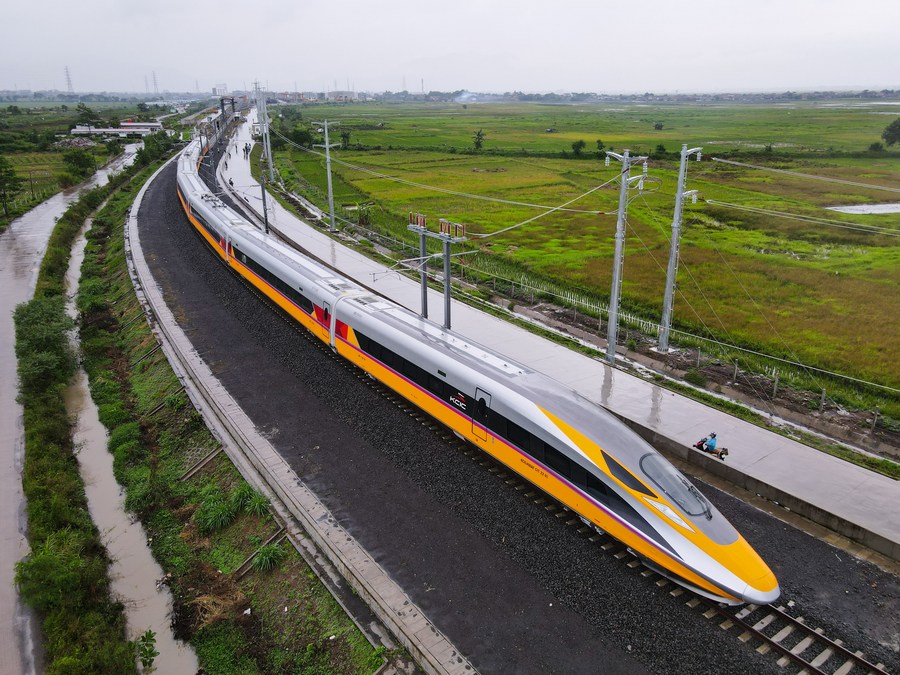
Illustration photo of the Vietnam North-South high-speed train. Photo: Vietnamnews
Vietnam is entering a decisive rail investment cycle, and the scale is drawing attention across the region. Its North to South high-speed rail plan is estimated at roughly $67 billion, with technology and equipment such as trains, carriages, signals, and tracks expected to account for up to 40% of total cost.
When urban rail programs are included across Hanoi, Ho Chi Minh City, and other cities, the overall opportunity is often estimated to exceed 100 billion USD through 2050. This is not only an infrastructure wave, but also an industrial and technology wave, with implications for technology transfer, localization, supply chain development, and long-term operational modernization.
Policy is also reinforcing that direction. Decree 319/2025/NĐ-CP, issued on December 12, 2025, is widely reported as a framework that prioritizes local participation and technology transfer mechanisms for major railway projects, creating clearer pathways for Vietnamese enterprises to join the supply chain.
On the operator side, digital transformation is already underway. Vietnam Railways has rolled out systems spanning surveillance, e-ticketing, e-payments, e-invoicing, baggage management, and station automation, and it has expanded digital customer channels including AI chatbot and AI-powered voice applications. From 2026 to 2035, published direction includes ambitious targets such as automating at least 90% of infrastructure management, maintenance, and operations, and building a centralized cloud-based data platform to support AI and IoT applications, with a longer-term aim of running core operational and technical processes through internal software systems.
FPT’s strategic approach through Railway Mobility Technology
Against this national momentum, FPT has positioned railway mobility as a strategic technology domain. In December 2025, FPT announced its Strategic Technology Steering Committee and established FPT Railway Mobility Technology (FMT) as one of five strategic units, alongside Quantum AI and Cyber Security Institute (QACI), FPT UAV (Unmanned Aerial Vehicles), FPT Cyber Security, and Digital Conglomerate 5.0 (DC5). FMT is led by Mr. Pham Minh Tuan, FPT Software CEO and EVP, FPT Corporation.
Illustration photo of the Vietnam North-South high-speed train. Photo: Vietnamnews
FMT is designed to build on the capabilities that FPT has already proven at scale. These include automotive software and engineering, semiconductors, IoT and SCADA systems for industrial environments, and experience supporting high-availability operations in safety-critical industries such as aviation, energy, and oil and gas.
FMT is also backed by an ecosystem approach. FPT participates in the AI Alliance led by IBM and Meta and maintains collaborations with institutions such as Mila and Landing AI to strengthen research and talent development. These partnerships help accelerate the adoption of proven methods while reducing risk through validation and shared learning. FPT also partners with NVIDIA to operate two AI factories in Japan and Vietnam, which ranked 36th and 38th globally in the June 2025 TOP500. That compute foundation supports the development and deployment of railway AI solutions across inspection, forecasting, optimization, and digital twin workloads.
With this combination of delivery maturity, ecosystem partnerships, and infrastructure, FPT is positioned to help deliver the intelligent railway stack from connectivity and edge AI to digital twins and predictive analytics, supporting a rail sector that is smarter, safer, and more sustainable.