



















The low‑altitude economy is emerging as a new layer of economic activity, reshaping how countries approach infrastructure, mobility, and advanced services. In Vietnam, this space is increasingly viewed not as a niche technology area, but as a strategic growth frontier with the potential to transform sectors ranging from logistics and agriculture to tourism and urban development.
As unmanned aerial vehicles (UAVs) evolve from experimental tools into operational platforms, low‑altitude airspace itself is beginning to be treated as economic infrastructure. With improvements in governance, connectivity, and talent development, Vietnam has the conditions to move early and build durable capabilities in this emerging field. Vu Anh Tu, Managing Director of FPT UAV, FPT Corporation, notes, “Looking at current forecasts, the low‑altitude economy has the potential to reach a scale of around USD 10 billion over the next 15 years, while creating a highly skilled workforce of close to one million people.”
Across the ecosystem, a consistent set of priorities is coming into focus: translating UAV capabilities into real operational services, accelerating adoption across high‑impact use cases, and building the foundations required for long‑term scale. These factors will determine how quickly the low‑altitude economy moves from potential to sustained impact.

Vu Anh Tu, Managing Director of FPT UAV, FPT Corporation
From Emerging Concept to Economic Infrastructure
In Vietnam, the low‑altitude economy is already moving beyond conceptual discussion, with UAV technologies being applied across practical scenarios including agriculture, logistics, surveying, and geospatial intelligence. These are areas where aerial data and mobility can deliver immediate gains in efficiency and decision‑making.
Industry projections suggest that, over the next decade, the low‑altitude economy could grow into a multi‑billion‑dollar market supported by a large, highly skilled workforce. A key inflection point has been the growing recognition of low‑altitude operations as a distinct economic layer, alongside surface‑level and underground infrastructure in long‑term planning.
This shift reflects a broader change in perception: UAVs are no longer viewed as standalone devices, but as part of integrated systems that must align with digital platforms, infrastructure planning, and economic strategy. FPT’s focus has been on translating this shift into deployable and scalable capabilities.
Turning UAV Capabilities into Scaled Applications
While UAV adoption in agriculture has already demonstrated clear productivity benefits, logistics is emerging as the next promising application area,particularly in Vietnam, where complex terrain and uneven infrastructure continue to challenge traditional transport models.
Through a series of pilots and collaborations, FPT has been testing drone‑based logistics for essential goods, medical supplies, time‑sensitive materials, and high‑value agricultural products. These initiatives are designed to generate operational insight by testing flight coordination, safety procedures, and scalability under real‑world conditions.
Beyond logistics, tourism also presents additional use cases. Vietnam’s distinctive natural landscapes and dispersed destinations create potential for low‑altitude aviation services that can enhance visitor experiences while easing pressure on ground infrastructure. FPT continues to study how UAV‑enabled services can be introduced in a responsible and sustainable manner.
Building Regulatory Confidence Through Practice
As the low‑altitude economy develops in Vietnam, regulatory clarity plays a decisive role in shaping adoption. Over time, more defined rules governing UAV manufacturing, training, and operations have helped establish a baseline for safety and compliance.
Within this evolving environment, research activities, pilots, and talent programs must align with emerging governance requirements. When the industry operates within these frameworks and feeds practical insights back into the ecosystem, it ensures that regulation and innovation evolve together.
Looking ahead, controlled testing environments and sandbox approaches are expected to accelerate progress. Drawing on international experience, FPT is contributing perspectives on how designated low‑altitude zones in major urban areas can enable experimentation while maintaining rigorous safety standards.
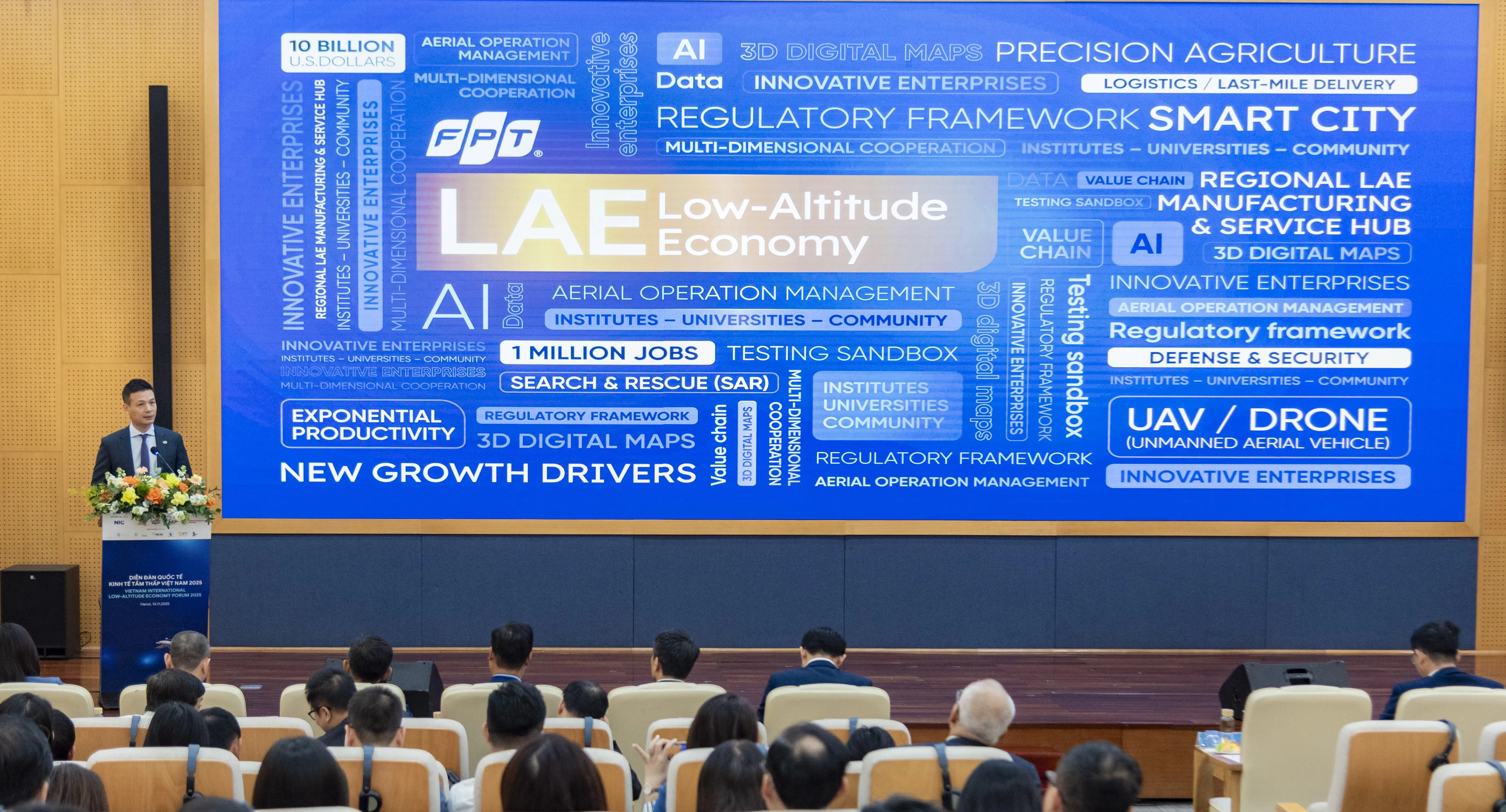
UAV is a strategic technology unit under FPT’s Strategic Technology Steering Committee
Laying the Foundations: Infrastructure and Talent
Scaling the low‑altitude economy requires more than aerial platforms alone. Supporting infrastructure—including ground facilities for take‑off and landing, clearly defined air corridors, and resilient digital connectivity—is essential for safe, large‑scale operations.Talent development is equally critical. While Vietnam has a solid technical pipeline with 560,000+ skilled IT professionals, the low‑altitude economy demands interdisciplinary expertise spanning aerospace systems, AI, data analytics, and operations. To address this gap, FPT is working with leading universities and partners to develop specialized training programs aligned with industry needs.
At the foundational level, FPT University produces over 2,000 AI and data graduates annually, forging international academic collaborations to introduce advanced curricula on emerging technologies. Its newly established Quantum AI & Cyber Security Institute (QACI) focuses on AI and next‑generation technologies, supporting postgraduate programs closely linked to UAV and low‑altitude innovation.
FPT’s Long‑Term Commitment to Strategic Technologies
Driven by a commitment to mastering strategic technologies, the establishment of FPT UAV has positioned FPT as an ecosystem builder for the low‑altitude economy, supporting Vietnam’s long‑term growth.
Through sustained investment in R&D, real‑world deployment, policy engagement, and talent cultivation, FPT is helping shape the evolution of the low‑altitude economy into a scalable sector. As this new economic layer continues to expand worldwide, FPT’s approach—grounded in execution and long‑term capability building—positions Vietnam to integrate more deeply in the next phase of low‑altitude growth.