





















AI may be the most transformative technology of our time, but transformation itself remains elusive. While AI adoption is accelerating across industries, only 23% of organizations have successfully scaled AI across the enterprise. Gartner's research suggests the challenge runs even deeper, with nearly 80% of agentic AI initiatives failing to reach production due to an inability to deliver measurable outcomes.
The lesson is clear: AI success is no longer determined by access to intelligence, but by an organization's ability to operationalize it. Scaling AI requires more than deploying models. It requires new operating models, governance structures, workforce capabilities, and technology foundations. This reality is shaping FPT's approach to AI transformation: maturity first, platform second, and outcomes always.
At the same time, FPT believes AI represents far more than a new technology wave. It is reshaping how enterprises operate, innovate, and create value. As organizations build the foundations required to scale AI, two opportunities emerge in parallel.
The first is redefining and accelerating legacy work. Enterprises around the world continue to rely on decades of accumulated systems, processes, applications, and business knowledge. AI provides an opportunity to modernize these environments at unprecedented speed by automating complexity, extracting insights from unstructured information, and embedding intelligence directly into service delivery. FPT leverages AI to fundamentally re-engineer traditional services such as managed services, embedded engineering, application maintenance, and legacy modernization, enabling organizations to move faster, improve quality, and unlock greater efficiency.
The second opportunity goes beyond optimization. AI is enabling the creation of entirely new services and business capabilities. Rather than acting solely as a service provider, FPT is increasingly helping clients co-create new operating models where human expertise and AI agents work together to achieve outcomes that were previously difficult, costly, or impossible. This shift transforms the role of technology partners from execution providers into strategic collaborators focused on business reinvention.
This perspective also informs FPT’s view on one of the most common assumptions surrounding AI—that automation will ultimately reduce demand for technology services. In reality, the company is seeing the opposite.
As AI becomes more embedded into business operations, it introduces new challenges around governance, quality assurance, cybersecurity, compliance and risk management. Many organizations can deploy AI tools, but far fewer have the capabilities required to manage AI at enterprise scale. As a result, demand is shifting toward what FPT describes as “services powered by AI”—services that are faster, more scalable, and more cost-efficient, while still maintaining the governance and trust required for enterprise adoption. AI is not reducing the need for services; it is amplifying it.
FPT occupies a particularly advantageous position in this market evolution. Enterprise-scale AI transformation requires a delicate balance between scale and agility. Smaller providers may offer speed and flexibility but often struggle to provide the governance, reliability, and delivery confidence demanded by large enterprises. Larger providers possess scale but can be slower to adapt, innovate, or co-create with clients. FPT operates in what it describes as the “sweet spot” between these two extremes—large enough to ensure enterprise-grade delivery, governance, and global execution, yet agile enough to move quickly, adapt to changing requirements, and work side-by-side with clients throughout their transformation journeys.
To turn this philosophy into execution, FPT has developed an integrated AI transformation model built around three interconnected layers: CASAN, FleziPT, and Digital Foundry.
The first layer, CASAN, is FPT’s AI maturity framework. Built around five stages of maturity—Curious, Augmented, Standard, Automated, and Native—CASAN helps organizations understand where they are in their AI journey and what capabilities they need to advance. The framework goes beyond technology adoption, assessing readiness across areas such as strategy, governance, data, operating models, and workforce capabilities. By providing a structured roadmap from experimentation to AI-native operations, CASAN helps enterprises align investments and transformation priorities with their actual level of maturity rather than pursuing AI initiatives in isolation.
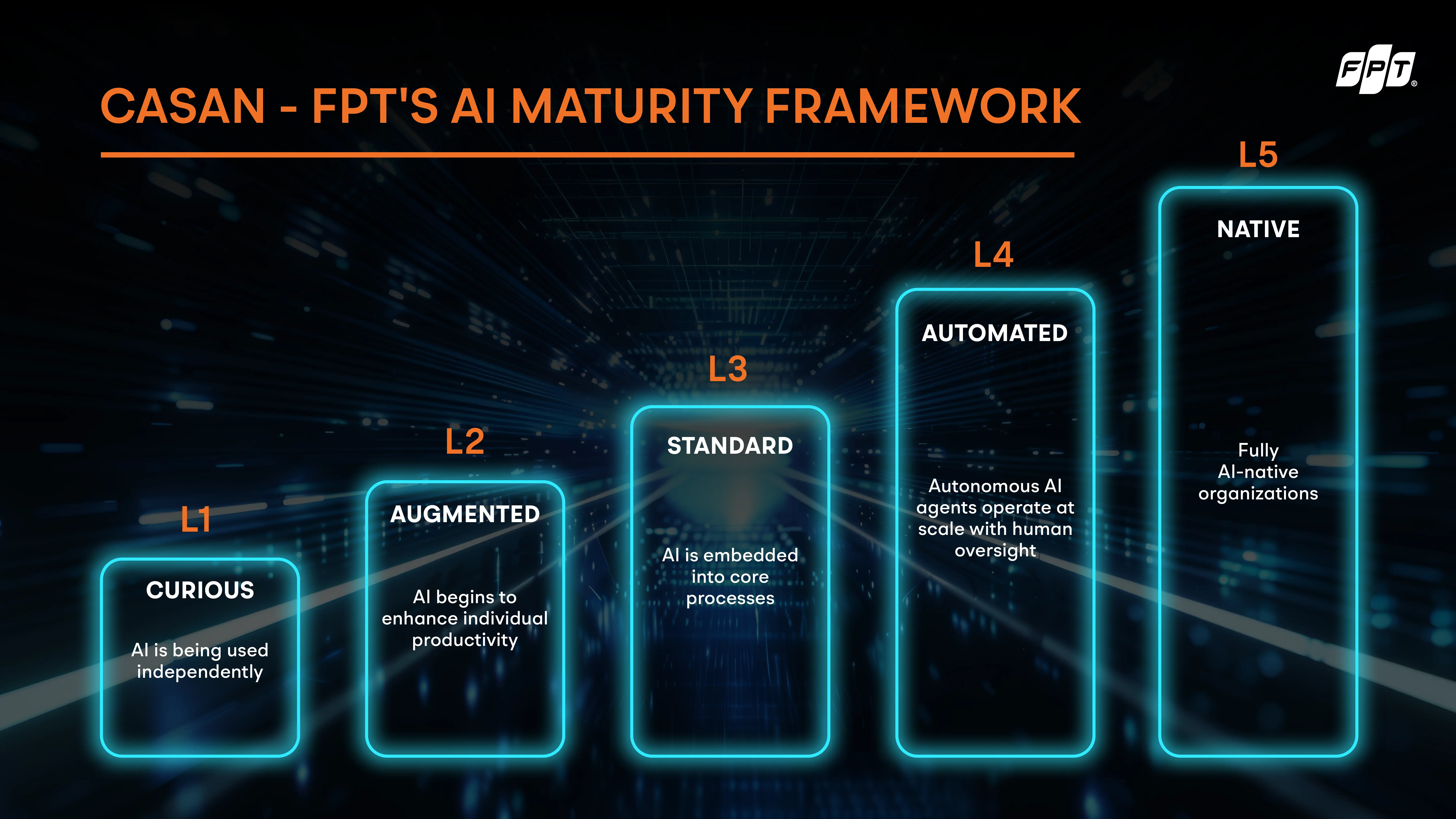
The rationale behind this maturity-first approach is increasingly reflected in industry research. Gartner has found that organizations with higher AI maturity achieve significantly stronger outcomes: they are four times more likely to have business units that trust and embrace AI, more than twice as likely to sustain AI initiatives in production, and substantially more likely to exceed leadership expectations on business results. These findings reinforce a central principle behind CASAN: long-term AI success depends less on access to technology and more on the ability to build the right foundations in governance, data, talent, and operating models.
The second layer, FleziPT, serves as the execution ecosystem. It combines platforms, talent, technology partnerships, and industry expertise to accelerate AI adoption while maintaining scalability and trust. Through FleziPT, organizations gain access not only to technology, but to an ecosystem capable of translating AI ambitions into enterprise-wide transformation initiatives.
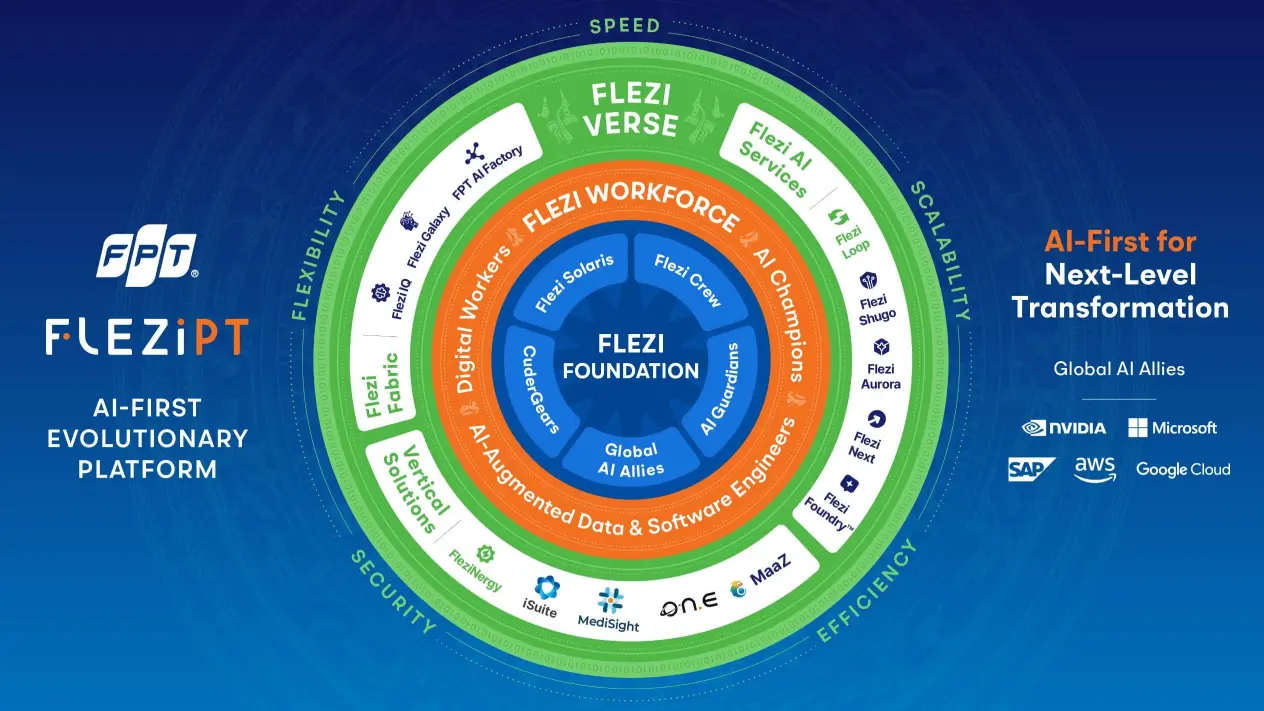
FPT FleziPT - AI-first Evolutionary Platform
A major strength of FleziPT lies in FPT’s global technology partnerships. The company has built deep relationships with leading AI and enterprise technology providers, including Microsoft, NVIDIA, SAP, and Anthropic. FPT today has more than 4,200 Microsoft-certified engineers and became Southeast Asia’s first Microsoft Enterprise System Integrator to achieve Frontier Partner status. It also holds more than 10,000 NVIDIA certifications, employs over 1,600 SAP consultants with more than 1,250 SAP certifications, and continues to expand its collaboration with Anthropic, with more than 2,000 Claude licenses and over 100 active Claude-based projects.
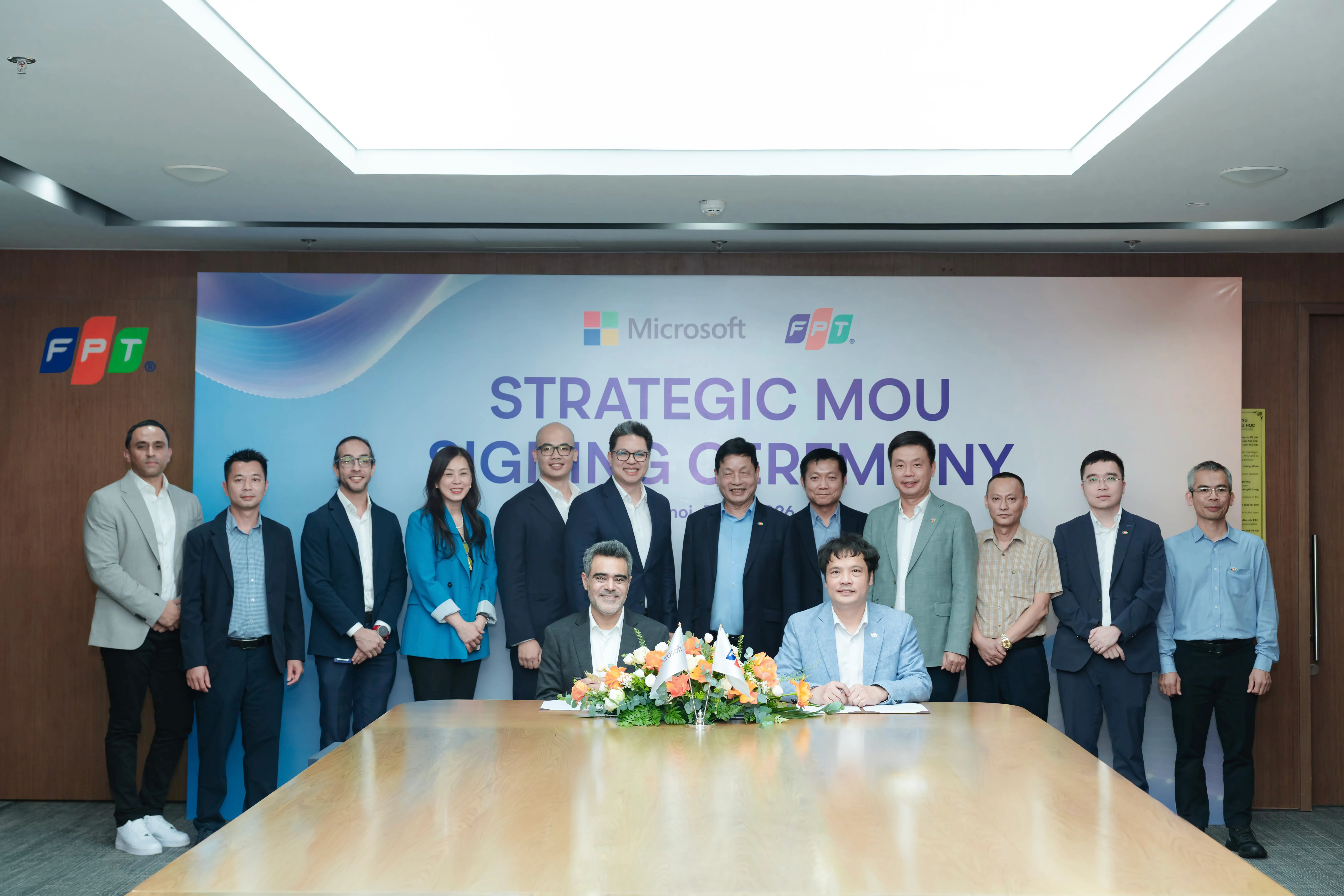
FPT expands strategic collaboration with Microsoft to advance AI frontier innovation
These partnerships are reinforced by FPT’s global delivery footprint and extensive industry expertise. The company supports more than 1,100 clients worldwide, including over 130 Fortune 500 enterprises, through a follow-the-sun delivery model spanning onshore, nearshore, and offshore locations. This combination of global reach and domain specialization allows FPT to deliver AI transformation across industries including financial services, manufacturing, automotive, healthcare, and energy.
Technology alone, however, does not drive transformation. Talent does.
Recognizing this, FPT has invested heavily in building one of the industry's largest AI-enabled workforces, with more than 30,000 AI-augmented engineers, supported by over 5,000 AI engineers and 3,000 data engineers. This workforce is equipped with a broad portfolio of AI tools, including GitHub Copilot, Claude, Microsoft Copilot, ChatGPT Enterprise, and FPT-developed solutions such as CodeVista and PrivateGPT.

Through extensive reskilling and certification programs, the company is also developing the next generation of AI Product Owners, AI Architects, and AI Engineers. Combined with strategic partnerships with global AI leaders, these initiatives help clients build the talent foundations required to scale AI and realize lasting business value.
The third layer of the framework, Digital Foundry, focuses on what ultimately matters most: outcomes. As an AI-powered software development and managed services platform, Digital Foundry helps organizations move beyond effort-based delivery models toward measurable business results. By combining human expertise, AI-augmented delivery, and outcome-based engagement models, it aims to improve productivity, accelerate innovation, optimize costs, and create sustainable business value.
More importantly, Digital Foundry bridges the gap between AI experimentation and enterprise-scale impact. By bringing together AI-ready platforms, governance, talent, and operational discipline, it helps organizations translate AI investments into measurable business outcomes and sustained competitive advantage.
Across industries, this approach is already delivering measurable results. For a leading automotive marketplace in the United States, FPT helped establish the foundations for enterprise-scale AI adoption, reducing reporting cycles from days to approximately 15 minutes. For a global chemical manufacturer, AI-powered supply chain and procurement solutions reduced request-handling times by 99%, from days to just minutes.
In Japan, FPT has helped enterprises modernize legacy operations and strengthen delivery resilience—from building a unified digital manufacturing platform for a major steel manufacturer to rebuilding critical operations for a leading ICT company in just 18 weeks. Together, these engagements demonstrate how AI transformation creates value not only through automation, but through modernization, operational resilience, and business growth.
As organizations around the world seek to move beyond AI experimentation, lasting advantage will belong to those that successfully combine technology, talent, governance, and execution into a coherent transformation strategy. Through its integrated model of CASAN, FleziPT, and Digital Foundry, FPT helps enterprises industrialize AI responsibly and at scale—transforming AI from isolated pilots into a sustainable engine for growth, resilience, and competitive advantage.


