






















Artificial intelligence has moved beyond experimentation. Across the 400 global enterprises surveyed in a new research by FPT, in collaboration with Forrester Consulting, 76.6% have already deployed AI across key functions, while only 8.1% remain at the individual-user stage. Predictive AI has reached production in 58% of organizations, Generative AI in 39%, and Agentic AI in 24%.
AI adoption is no longer the question. The challenge is turning adoption into enterprise-wide value.
The gap becomes apparent when looking at deployment maturity. Although AI usage is widespread, only 22.9% of organizations have achieved enterprise-wide deployment under a coordinated strategy. Most remain at the departmental level - deploying local initiatives but without the governance, operating models, or foundations required for enterprise-wide transformation.
This does not mean AI is failing. In fact, organizations are already seeing measurable returns. The most commonly realized benefits include faster, more consistent decision-making (41%), workforce productivity improvements (41%), and operational efficiency gains (38%). AI is helping enterprises accelerate decisions and improve execution; however not yet fundamentally changing how most operate or compete.
The next phase of AI therefore looks less like automation and more like organizational redesign. The study shows that increasingly, enterprises are building operating models around collaboration between human employees, AI assistants, copilots, digital workers, and autonomous agents. Workforce productivity is a strategic objective for 43% of organizations, while 36% explicitly identify the creation of an AI-augmented workforce as a priority. The future enterprise is unlikely to be fully autonomous; it is far more likely to be built on effective human–AI collaboration at scale.
The biggest obstacles to achieving that vision are not technical limitations in AI models. They are enterprise barriers. Integration with legacy systems remains the most frequently cited operational challenge (41%), followed by data silos (38%), and insufficient data readiness (36%).
At the same time, trust has emerged as a prerequisite for AI scale. Cybersecurity is now the leading concern (42%), while data sovereignty (37%), privacy and regulatory compliance (36%), and governance maturity remain major challenges. Organizations increasingly recognize that AI cannot become embedded in critical operations unless it is secure, explainable, auditable, and governed.
These realities are reshaping investment priorities. Rather than funding more pilots, organizations are investing in the foundations required to industrialize AI. Governance and compliance readiness rank as the leading investment area (44%), followed by AI integration (42%), reusable AI platforms (39%), security and resilience (38%), and data modernization (36%). AI is shifting from a technology agenda to a business transformation agenda, where success is measured not by deployment volume but by business outcomes, operational impact, and growth.
The same shift is visible in what enterprises expect from external partners. Organizations increasingly prefer platform-led partnerships (62%), managed services (58%), and co-innovation models (50%). Nearly half prioritize partners that can engineer and operate AI systems at enterprise scale, while an equal proportion prioritize governance, security, and compliance capabilities.

The company has cultivated thousands of experts holding over 97,000 professional certifications to deliver high‑quality, industry‑tailored solutions
The expectation is clear: enterprises are no longer looking for AI vendors. They are looking for transformation partners capable of evolving strategy, operations, workforce, governance, and technology foundations simultaneously.
FPT Perspective: From AI Pilots to AI-Powered Enterprises
The research makes one thing clear: the challenge facing enterprises is no longer AI adoption. With AI already deployed across much of the enterprise landscape, the next phase is about scaling AI into a sustainable source of business value. Organizations must modernize legacy environments, build trusted and resilient operations, accelerate how new value is created, and redesign the way work is governed and executed.
To help organizations navigate this transition, FPT has developed two complementary pillars for enterprise AI transformation: CASAN, its enterprise transformation framework, and FleziPT, its AI-powered execution ecosystem. Together, they provide a structured approach for moving from isolated AI initiatives to enterprise-wide transformation.
The research shows that successful AI transformation requires enterprises to tackle four priorities simultaneously.
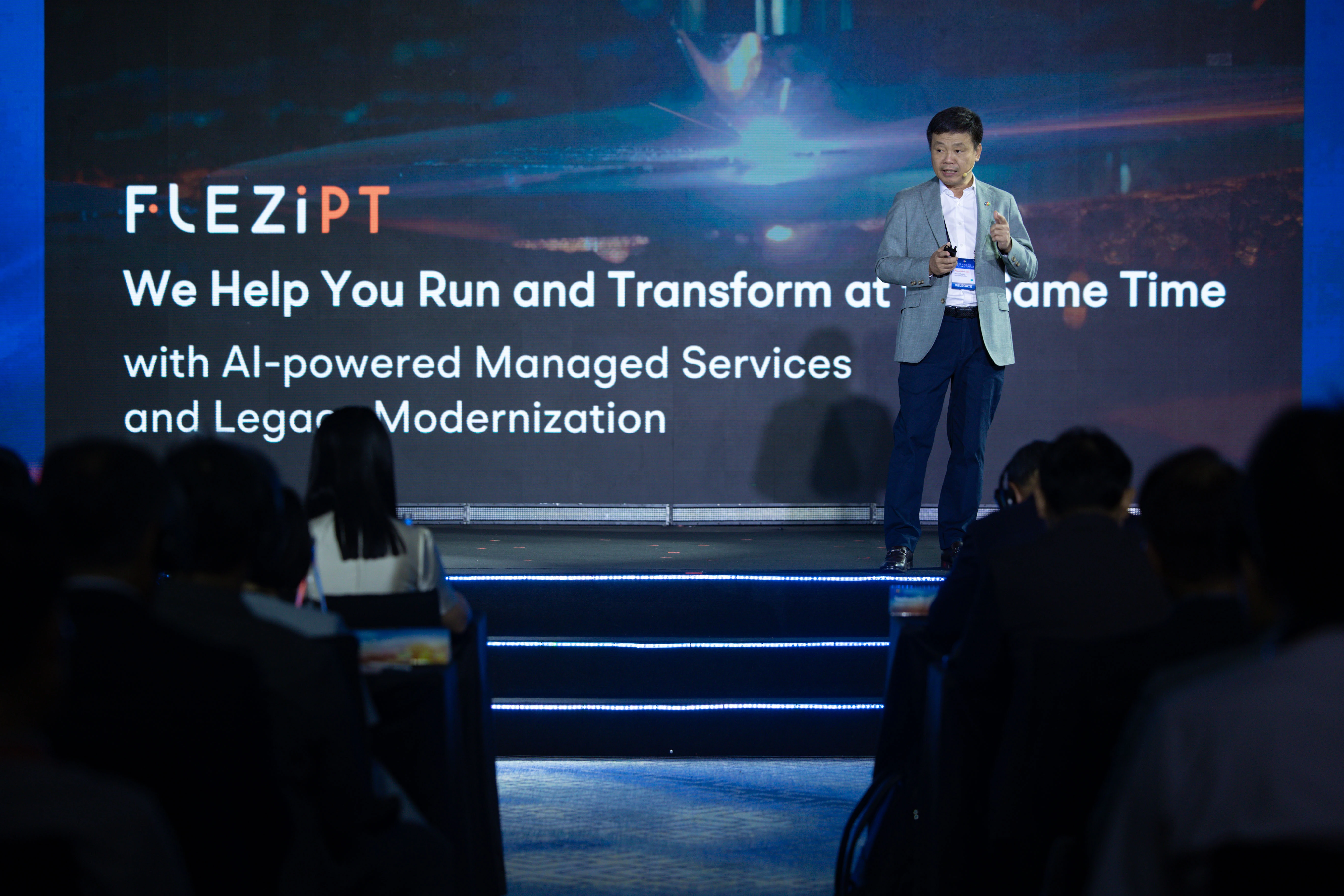
Pham Minh Tuan, Executive Vice President and FPT Software Chief Executive Officer, FPT Corporation, highlights FleziPT AI platform, designed to help enterprises adopt AI with flexibility and ease
First, they must run and transform at the same time. Legacy systems remain one of the biggest barriers to AI scale, and many organizations continue to devote 60–80% of IT spending to maintaining existing environments. Through solutions such as Flezi Aurora, Flezi NEXT, and Flezi Metis, FleziPT helps organizations modernize while maintaining business continuity and preserving institutional knowledge. AI-powered managed services create an always-on operating model that combines multi-agent automation with human oversight, while industrialized modernization capabilities accelerate transformation of legacy applications and infrastructure, with proven outcomes including up to 80% faster release cycles and up to 70% cost savings.
Second, enterprises must build trusted and resilient operations. As the research highlights, cybersecurity, governance, compliance, and sovereignty have become prerequisites for AI scale. FPT addresses these challenges through an integrated set of capabilities spanning knowledge preservation, AI orchestration, cybersecurity, and AI infrastructure. Flezi Metis transforms legacy systems and documentation into structured AI knowledge assets that enable continuity across teams, vendors, and locations. Flezi Galaxy orchestrates AI-driven workflows while maintaining governance and control. Flezi Shugo provides AI-native cybersecurity capabilities designed to identify, prioritize, and remediate risks at scale, enabling organizations to respond to critical threats in less than 15 minutes while automating up to 90% of security alerts. These capabilities are complemented by FPT AI Factory and Flezi Loop, which provide the enterprise-scale infrastructure, governance, and lifecycle management required to deploy and operate AI securely and responsibly.

FPT AI Factory, powered by NVIDIA platforms (HGX B300, H100 and H200), serves as a high-performance engine for inference-heavy and agentic AI workloads
Third, organizations must accelerate how new value is created. As human employees increasingly work alongside copilots, digital workers, and autonomous agents, delivery models are shifting from effort-based execution toward outcome-based execution. FPT's Digital Foundry™ model is designed to support this transition. Combining domain expertise with governed fleets of AI agents operating across planning, engineering, testing, security, documentation, and operations, Digital Foundry shifts delivery from effort-based models toward outcome-based execution. The result is faster innovation cycles, continuous learning across engagements, and measurable improvements in productivity, including more than 30% gains in delivery velocity, while enabling automation of a significant portion of routine operational work.
Ultimately, however, AI transformation is not a technology program—it is an operating model transformation. This is the role of CASAN, FPT's enterprise AI transformation framework. Built around a five-stage maturity journey—Curious, Augmented, Standard, Automated, and Native—CASAN provides organizations with a structured pathway from experimentation to AI-native operations. The framework embeds governance, accountability, risk management, and measurable business outcomes into every stage of transformation, helping organizations scale AI responsibly across the enterprise.
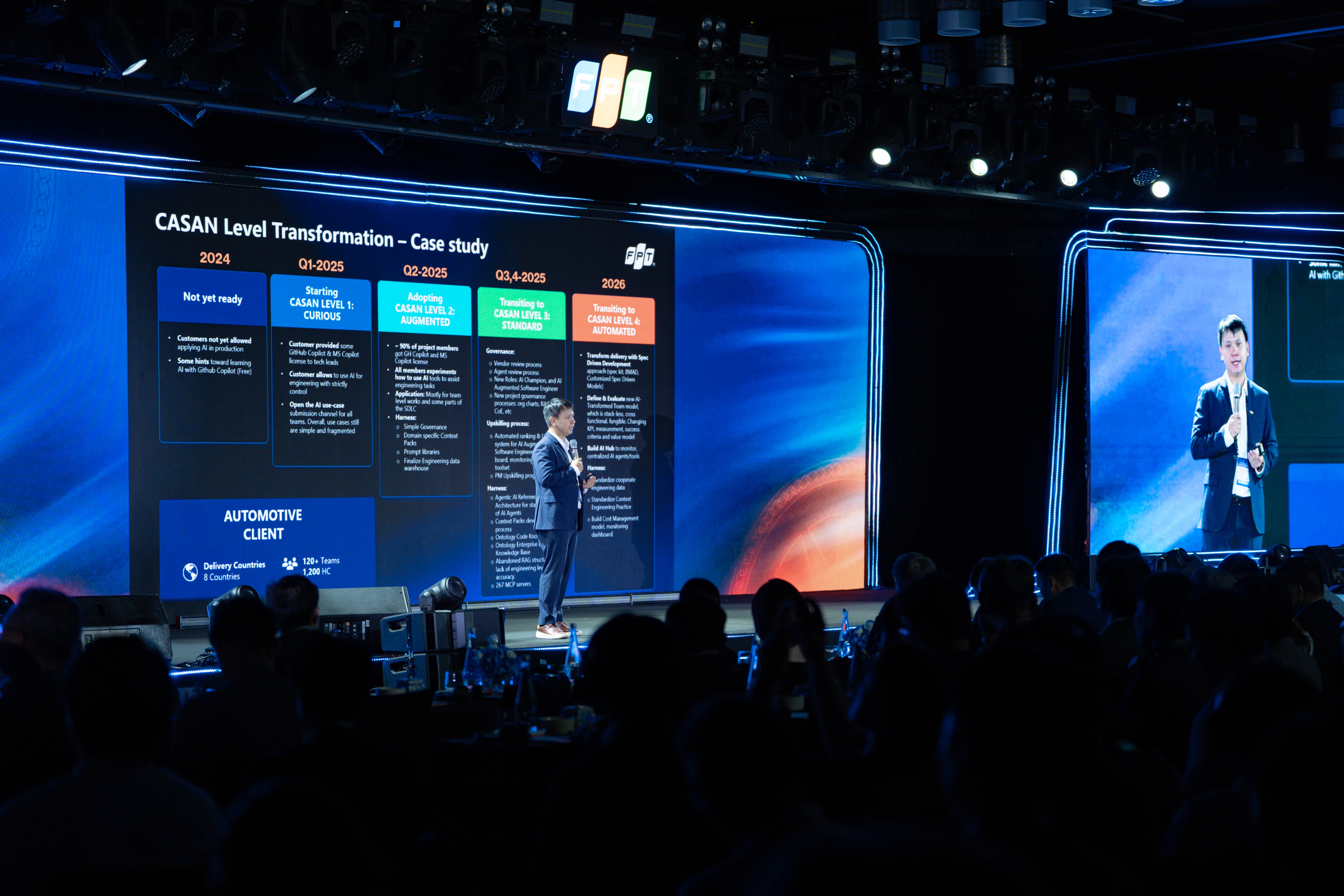
Nguyen Xuan Phong, FPT Corporation Chief AI Transformation Officer, FPT CASAN, outlined FPT’s CASAN AI transformation methodology with structured roadmap
Looking ahead, FPT is extending this vision through an AI-native operating system designed to orchestrate work across people, AI agents, and enterprise systems. By enabling a human-led, AI-first workforce and creating a continuously learning environment that measures, optimizes, and improves outcomes over time, CASAN OS aims to transform AI from a collection of technologies into a durable enterprise capability.
More importantly, AI is proving to be far more than a cost-reduction tool. Across FPT's markets, productivity gains of 20–30% are frequently accompanied by larger and longer transformation programs, reinforcing that AI creates opportunities for growth, innovation, and business reinvention rather than simply reducing work.
As enterprises move beyond pilots and toward industrialized AI, they increasingly require both scale and agility. Smaller providers may lack governance and delivery capacity, while larger providers can struggle to adapt quickly. FPT operates at the intersection of both—combining global scale with the flexibility to co-create and innovate alongside its clients. This is reinforced by an ecosystem of more than 1,100 clients worldwide, 130+ Fortune Global 500 companies, strategic partnerships with Microsoft, NVIDIA, SAP, and Anthropic, and a workforce of 30,000+ AI-augmented engineers.

FPT and Microsoft recently expanded a strategic collaboration to advance AI Frontier innovation across Asia
Ultimately, becoming a Frontier Company is not about deploying more AI tools. It is about building an organization capable of continuously learning, adapting, and scaling human–AI collaboration. The enterprises that succeed will be those that transform not only their technology, but also their operations, governance, workforce, and culture—turning AI into a sustainable engine for long-term growth and competitive advantage.


