


The NHS Federated Data Platform (FDP), built on Palantir Foundry, is one of the most ambitious data transformation programmes in UK healthcare. It introduces a federated architecture that enables NHS organisations to connect data across systems and regions while still maintaining local control. However, despite the scale of national investment and the strength of the platform itself, the primary challenge is not deployment — it is integration.
For most NHS Trusts and Integrated Care Boards (ICBs), there remains a significant gap between having access to FDP and actually generating value from it. The platform provides a powerful foundation, but without robust data engineering practices, clear governance structures, and strong operational alignment, its potential is difficult to realise. Bridging this gap demands not only deep technical expertise but also practical delivery experience in integrating complex, multi-system healthcare environments.
Understanding FDP Beyond the Technology
A frequent misconception is to treat the FDP as a single, centralised data warehouse. In practice, it is designed as a federated system. Data is not lifted into one national repository; it stays within local environments such as electronic patient records, pathology systems and workforce platforms, and is made interoperable through standardised pipelines and shared data models.
Palantir Foundry underpins this federated model by providing the core infrastructure: scalable ingestion pipelines, semantic data modelling via its ontology layer, full data lineage tracking and fine-grained access control. From the perspective of a Trust or Integrated Care Board (ICB), the FDP should therefore be understood not as a replacement for existing systems but as an extension of the local data estate, connecting fragmented datasets into a coherent and governed whole.
This distinction matters because it shifts accountability. Rather than relying on a national platform to resolve data quality and integration issues, individual organisations are responsible for preparing, standardising and governing their own data environments within the federated framework.
The reality of integration at Trust and ICB level
At Trust level, integration is rarely straightforward. Clinical and operational systems have evolved over time, often supplied by different vendors, each with its own data structures and standards. As a result, the local technology landscape is typically fragmented rather than designed for a federated architecture.
Integration challenges at Trust level
Within a single Trust, key operational systems usually operate in silos, connected only through legacy integration methods. These systems commonly include:
- Patient administration systems
- Imaging platforms
- Laboratory systems
- Workforce and rostering tools
Because these systems were never designed to work together as part of a federated model, data inconsistencies tend to become the norm. Core identifiers and operational metrics are often misaligned across platforms:
- Patient identifiers may differ between systems
- Clinician records may not align
- Operational data frequently lacks standardisation
Attempting to integrate these datasets into an FDP environment without first addressing these issues typically leads to delays and limits the analytical value that can be generated.
Integration challenges at ICB level
At ICB level, the challenge becomes significantly more complex. Integration is no longer confined to a single organisation but spans multiple Trusts and care providers, each at a different stage of digital maturity. The inclusion of community care, mental health and social care services adds further variability to the data landscape.
Delivering meaningful population health insights at this scale requires more than technical connectivity. It depends on consistent agreement across organisations in areas such as:
- Data definitions and how key fields are interpreted
- Governance arrangements for data use and sharing
- Access policies that define who can see which data and for what purposes
Without a structured and phased approach, FDP onboarding at ICB level often turns into a prolonged effort dominated by data harmonisation tasks. This delays the point at which the platform can generate actionable insights and meaningfully support decision-making.
What does technical readiness for FDP really involve?
Technical readiness for FDP goes far beyond wiring systems together. It is the ability to run robust data pipelines, model information through a shared ontology, and govern it in a way that clinicians and leaders can consistently trust. This level of maturity is what enables organisations to realise the full value of Palantir Foundry.
Robust data engineering as the first foundation
Successfully leveraging FDP starts with strong data engineering. Reliable ingestion pipelines, whether API-driven or event-based, must replace fragmented batch processes that are hard to maintain and slow to update. Data quality has to be validated within the pipeline itself, rather than treated as a downstream clean-up exercise.
Foundry’s orchestration capabilities are powerful, but they can only operate effectively on clean, consistent upstream data. When inputs are unstable or poorly integrated, even the most advanced orchestration quickly hits its limits.
Ontology-driven data modelling
Equally important is an ontology-driven approach to data modelling. Palantir Foundry’s strength lies in representing real-world stakeholders and assets — such as patients, care pathways and the workforce — as reusable, semantic objects. This makes it possible to interpret data in a consistent way across different systems and organisations.
However, reaching this point requires Trusts and ICBs to map their local data structures to shared standards such as FHIR, SNOMED and ICD. Organisations that depend on ad-hoc transformations may achieve short-term outcomes, but they accumulate technical debt that constraints future interoperability and scalability.
Governance in a federated environment
Governance forms the third pillar of technical readiness. In a federated environment, trust in data is essential. This is not only about regulatory compliance, but also about ensuring that clinicians and operational leaders can rely on the information presented to them in their daily decisions.
Role-based access controls, clear data lineage and alignment with NHS governance frameworks are all necessary to build this trust. Without these elements in place, even the most sophisticated analytics capabilities can struggle to gain adoption and to be embedded into routine practice.
FPT’s Role in Enabling FDP Integration
FPT’s approach to FDP integration is grounded in hands-on experience delivering large-scale Palantir Foundry platforms, where integration complexity and cross-organisational data coordination are central challenges.
Practical, end-to-end FDP integration approach
This experience spans building scalable data ingestion pipelines, designing ontology-aligned data models, and developing data products that support real operational workflows. The focus is not on dashboards alone, but on enabling better decisions, whether that means improving patient flow, optimising workforce allocation, or enhancing system-wide planning.
Combination of technical and healthcare domain expertise
A key differentiator is the blend of deep technical expertise with healthcare domain understanding. Translating clinical and operational requirements into effective data models requires more than platform knowledge; it demands an appreciation of how healthcare services function in practice. This ensures that FDP outputs are not only technically correct, but also meaningful and usable for the clinicians, managers, and operational teams who rely on them.
Operationalising FDP with Palantir Foundry in the NHS
The diagram illustrates how a typical NHS organisation can operationalise the Federated Data Platform (FDP) using Palantir Foundry, moving from fragmented source systems to governed, reusable data products.
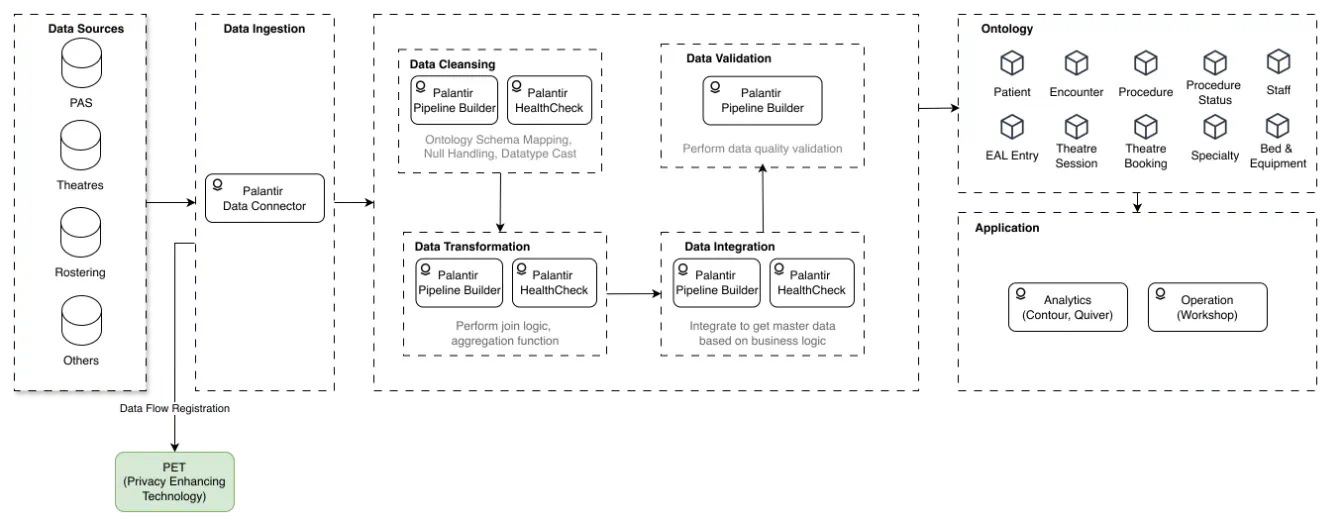
Data originates from multiple operational systems such as PAS, theatres, and rostering. It is ingested through standardised connectors, with privacy-enhancing controls applied at the point of entry. Once ingested, the data flows through structured processing stages. These include cleansing (to standardise formats and resolve nulls), validation (to ensure data quality), and transformation and integration (to join datasets and create business-aligned master views).
The processed data is then mapped into an ontology layer, where core healthcare stakeholders – such as patients, encounters, procedures, and staff – are represented in a consistent, semantic model aligned with NHS standards. This ontology serves as the foundation for downstream applications, enabling both analytics (for example, dashboards and reporting) and operational workflows (for example, decision support tools) to operate on trusted, reusable data.
Within the context of FDP, this flow highlights that value is not created at ingestion alone, but through disciplined data engineering, strong governance, and ontology-driven design that ultimately supports real-time, high-trust healthcare operations.
Lessons from a Large-Scale Palantir Deployment
FPT’s experience with a large-scale aviation data platform offers a concrete view of how federated data platforms can be implemented in complex, highly regulated environments. Built on Palantir Foundry, the platform integrates data from aircraft sensors, maintenance systems, supply chains, and multiple organisations across a highly distributed ecosystem. The parallels with the NHS Federated Data Platform (FDP) are significant. In both contexts, data is owned and managed by many different parties, governance requirements are stringent, and there is a need to generate insights that cut across organisational boundaries.
From this deployment, several practical lessons emerge that are directly relevant to large-scale federated data initiatives:
- Start with a robust ontology: Organisations that invested early in defining consistent data models and ontologies were able to scale more quickly and to reuse data products across teams and use cases more effectively.
- Treat governance as an enabler of collaboration: Governance is not only a technical or compliance requirement; it is a prerequisite for meaningful data sharing. Participants are willing to share data only when they trust how it will be accessed, used, and protected.
- Deliver incrementally around high-value use cases: Attempting to integrate everything at once often introduces unnecessary complexity and delays. By focusing on a small number of high-value use cases and expanding the platform over time, organisations can realise early benefits while steadily building momentum.
Turning FDP into Real Value
The Federated Data Platform offers a strong technical foundation, but many organisations struggle to turn this capability into measurable value without robust data engineering practices, clear governance frameworks, and close alignment with day-to-day operational workflows.
Trusts and ICBs are more likely to succeed when they treat FDP as a strategic platform investment rather than a reporting tool. This requires investing in data architecture, aligning data models across the organisation, strengthening governance, and adopting an incremental delivery approach. FPT can accelerate this journey by bringing proven experience, reducing integration risks, and helping ensure that technical implementation consistently translates into operational value.
The platform is already in place. The question is no longer whether FDP can deliver value, but how quickly organisations can unlock it.